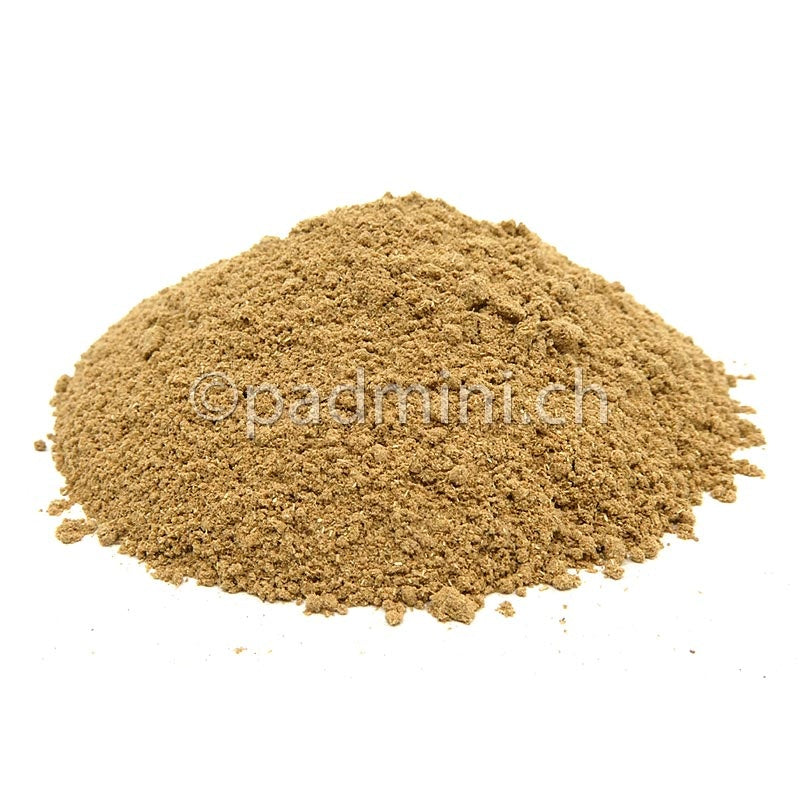
Baieido Makko Powder – Japanese Binder for Incense Making
Baieido Makko Powder – Japanese Binder for Incense Making
0483
Couldn't load pickup availability
Product description
Baieido Makko Powder is a traditional Japanese ingredient used to make incense sticks, incense cones and other hand-shaped incense. This exceptionally finely ground, light beige to light brown plant material is obtained mainly from the bark of the Tabu tree (Machilus thunbergii). It acts as a natural binder while also supporting an even burn.
Produced by the Japanese incense manufacturer Baieido, this Makko powder has a very subtle scent of its own, with slightly woody to vegetal notes. This allows the fragrances of the aromatic woods, herbs, spices and resins blended with it to develop largely without interference.
Makko and the Japanese Tabu tree
The evergreen Tabu tree belongs to the laurel family (Lauraceae) and is widespread in East Asia. It grows in Japan, Korea, Taiwan and China, among other places. Its bark contains natural mucilaginous substances that swell on contact with water, forming a sticky, slightly elastic mass.
In Japan, the tree is known as Tabu, Tabu no Ki or Tabunoki. The powdered bark obtained from it is also known as Tabuko or Tabu-ko. The name Makko, commonly used in the Western incense trade, refers particularly to this traditional base ingredient for incense making.
Baieido Makko Powder is produced in Japan. The precise geographical origin of the tree bark used for this batch is not documented.
Natural binder and foundation for an even burn
Makko performs three important functions in incense making:
- Natural binder: When water is added, the bark powder develops its adhesive properties and binds the finely ground ingredients together.
- Shaping: The resulting pliable mixture can be formed into thin incense sticks, cones, spirals and other shapes.
- Even burning: Once completely dry, Makko supports the slow and continuous spread of the glowing ember through the incense.
These properties make it possible to produce Japanese-style incense sticks without a bamboo core, synthetic adhesive or saltpetre. Makko provides the foundation that holds the aromatic ingredients together and allows them to burn in a controlled manner.
Traditional use in Japanese incense making
The use of powdered Tabu bark has long been part of the Japanese tradition of making combustible incense. This plant-based binder plays a particularly important role in incense sticks made without a bamboo core.
Traditionally, finely ground aromatic woods, spices and other incense materials are mixed with Tabu powder. After water is added, the mixture is carefully kneaded, shaped and then slowly dried.
This process produces incense sticks, cones, spirals and other forms of incense whose composition and fragrance can be individually developed through the choice of raw materials.
Making your own incense sticks and incense cones
The finely ground Makko powder is suitable both for initial experiments with homemade incense and for developing your own recipes. It combines particularly well with very fine aromatic wood powders such as sandalwood. Other dried plants, spices and small quantities of finely ground resins can also be included in a blend.
For a first attempt, a mixture of approximately equal parts by weight of Makko and aromatic ingredients is recommended. This 1:1 ratio makes it easier to get started, as it supports binding and continuous burning. However, it is not a universal recipe: depending on the raw materials used, considerably less Makko may be sufficient once you have gained experience.
Simple incense-making instructions
- Prepare the powders: Grind all aromatic ingredients as finely as possible and sieve them if necessary. The raw materials must be completely dry.
- Mix the dry ingredients: Thoroughly combine the Makko powder with the selected wood, plant or spice powders.
- Add water: Gradually add a few drops of water and knead the mixture thoroughly. The Makko will develop its natural binding properties during this process.
- Prepare the dough: Continue kneading until the mixture becomes uniform, pliable and slightly elastic, neither crumbling nor excessively sticky.
- Shape the incense: Form the dough into thin incense sticks, small cones or other desired shapes.
- Dry slowly: Allow the incense to dry completely in a dry, well-ventilated place protected from direct sunlight. Depending on the thickness and humidity, this may take approximately one week or longer.
- Test the burn: Only after the incense has dried completely, light a test piece and check whether the glowing ember continues to spread evenly.
The amount of water required and the optimal proportion of Makko depend on the composition of the blend. Recipes containing particularly high proportions of resin can be more difficult to work with and may interfere with burning. It is therefore advisable to start with small quantities and record the weight ratios used.
As you gain experience, the proportion of Makko can be gradually reduced to give the aromatic ingredients more prominence. The key is to find the right balance between ease of shaping, strength after drying, fragrance development and reliable burning.
Product information
- Manufacturer: Baieido, Japan
- Country of production: Japan
- Botanical name: Machilus thunbergii Siebold & Zucc.
- Botanical family: Lauraceae (laurel family)
- Plant part used: mainly finely ground tree bark
- Other names: Makko, Makkō, Tabu, Tabu no Ki, Tabuko
- Appearance: very fine, light beige to light brown plant powder
- Natural scent: very subtle, slightly woody to vegetal
- Use: making incense sticks, incense cones, spirals and shaped incense
- Available quantities: 100 g, 250 g or 500 g
Note: Handle this very fine powder in a way that minimises dust and avoid inhaling it. Intended exclusively for incense making and burning, not suitable for consumption. Burn finished incense only on a suitable fireproof surface and never leave it unattended.